
One sentence sits on our homepage, and it is the oldest engineering claim ever made. Natural selection, Darwin wrote in 1859, is daily and hourly scrutinising every variation, even the slightest; rejecting that which is bad, preserving and adding up all that is good. Read it as an engineer rather than a naturalist and something becomes visible that the biology tends to hide. Selection invents nothing. It has no ideas. It does not know what an eye is for. It is a governor — a mechanism that sits above a process and decides what the process is allowed to keep.
That is the subject of this series. Not intelligence, and not speed. The thing above the loop.
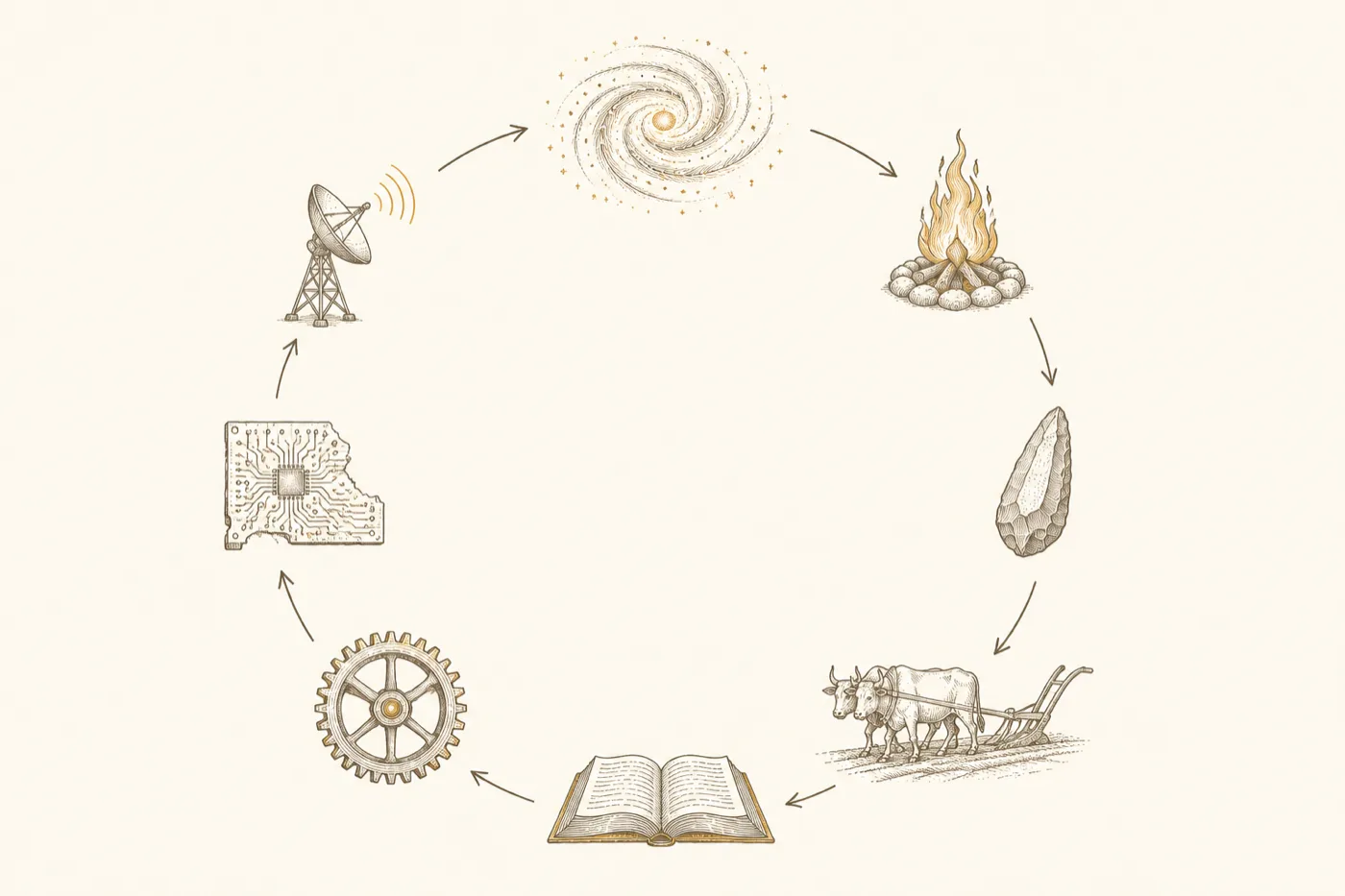
The environment has no opinion
Begin with what is doing the scrutinising. It is not a designer and not a teacher; it is a universe, and a universe is a strange kind of instructor because it never says anything. It does not explain. It does not grade. It answers, and only when asked, and only in the currency of consequence.
Everything a living thing has ever learned was extracted from that silence by putting a question to it and surviving the answer. A telescope is a question about the sky. A dropped stone is a question about weight. A protein folded a new way is a question about chemistry, asked without anyone intending to ask it, and answered within a generation by whether the organism carrying it had children. The signal is always the same shape: something was tried, something happened, and the record of what happened is all that comes back.
We labour this point because the equivalent claim about machines is usually made backwards. The environment is not a dataset the system consumes. It is the thing that closes the loop. And what makes something a learning signal is not where it came from — a test suite, a measurement, a paragraph written by an expert, the system’s own trace read back — but the position it occupies: it arrives after the attempt and it carries the consequence.
Three places an improvement can be kept
Now ask a narrower question. When a lineage does improve, where does the improvement physically go? There are only three answers, and every living thing that has ever improved at anything has used all three.
Into the surroundings. The flint, the fire, the coat, the wheel, the alphabet, the library, the search engine. Everything outside the mind that makes the mind more capable. This is the cheapest place to put an improvement and the fastest: an invention is available the afternoon it exists, to anyone who can pick it up. It also has to be carried. A capability that lives in your tools is a capability you lose the moment you set them down, and the coat that saved you in one climate is dead weight in another.
Into the inheritance. The genome — the only part of a human being that is transmitted. This is the expensive place, and the durable one. A capability written here costs nothing to use, needs no equipment, and is present at birth: a newborn does not learn to suckle. It is also the slowest possible place to write, because the write operation is a generation long and the pen is held by whoever survived.
Into what gets practised. Experience pressed into something transmissible — the drill, the exercise, the worked example, the textbook. This is the layer that has no memory of its own; it is the traffic between the other two. It is also, as we have argued elsewhere, entirely artificial: no exercise was ever found in the wild.
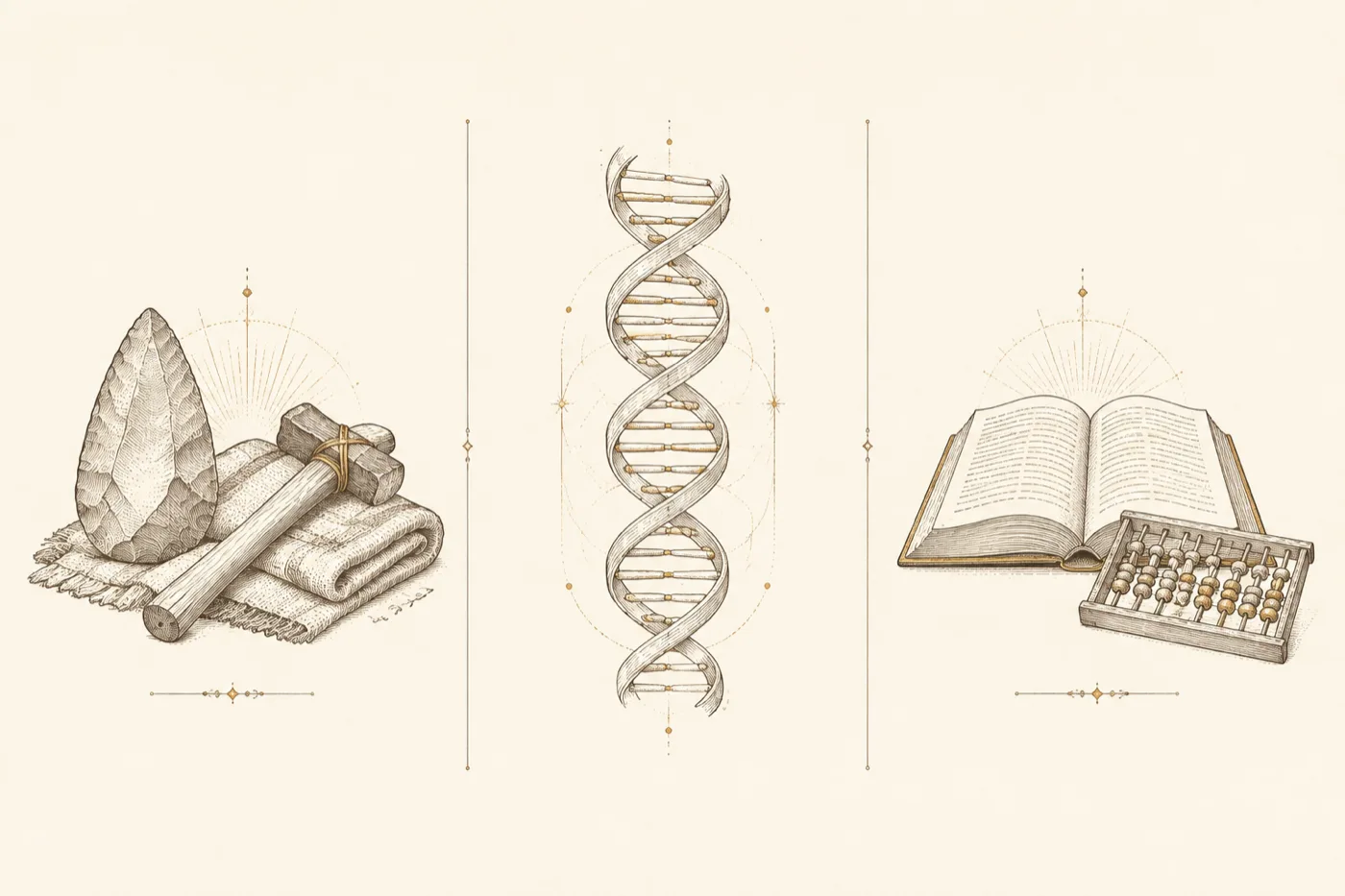
Read history along those three lines and it stops looking like a sequence of events. Fire and flint are the surroundings. Brain volume and the human vocal tract are the inheritance. The book is the strangest of the three, and it is worth asking why it exists at all.
Why there are libraries
Here is our answer. A library is a workaround.
Consider an astronomer who, after a life of looking, understands something true about the sky. That understanding is now in a mind. It cannot be moved into the genome — not by wanting it, not by discipline, not by writing it down a thousand times. Humans possess no mechanism for internalising a learned fact into what they transmit. The one thing selection did manage to favour was the disposition: curiosity, memory, a taste for pattern, the anatomy that makes speech possible. Never the content.
So the content had to go somewhere else, and it went outside — into speech, then clay, then paper, then everything. The ten thousand years of record that we keep pointing at is not a triumph of civilisation over nature so much as a very long, very beautiful compensation for a missing step. We are a species that solved external memory to a fantastic degree because the internal route was closed. Every library on Earth is scaffolding around an absence.
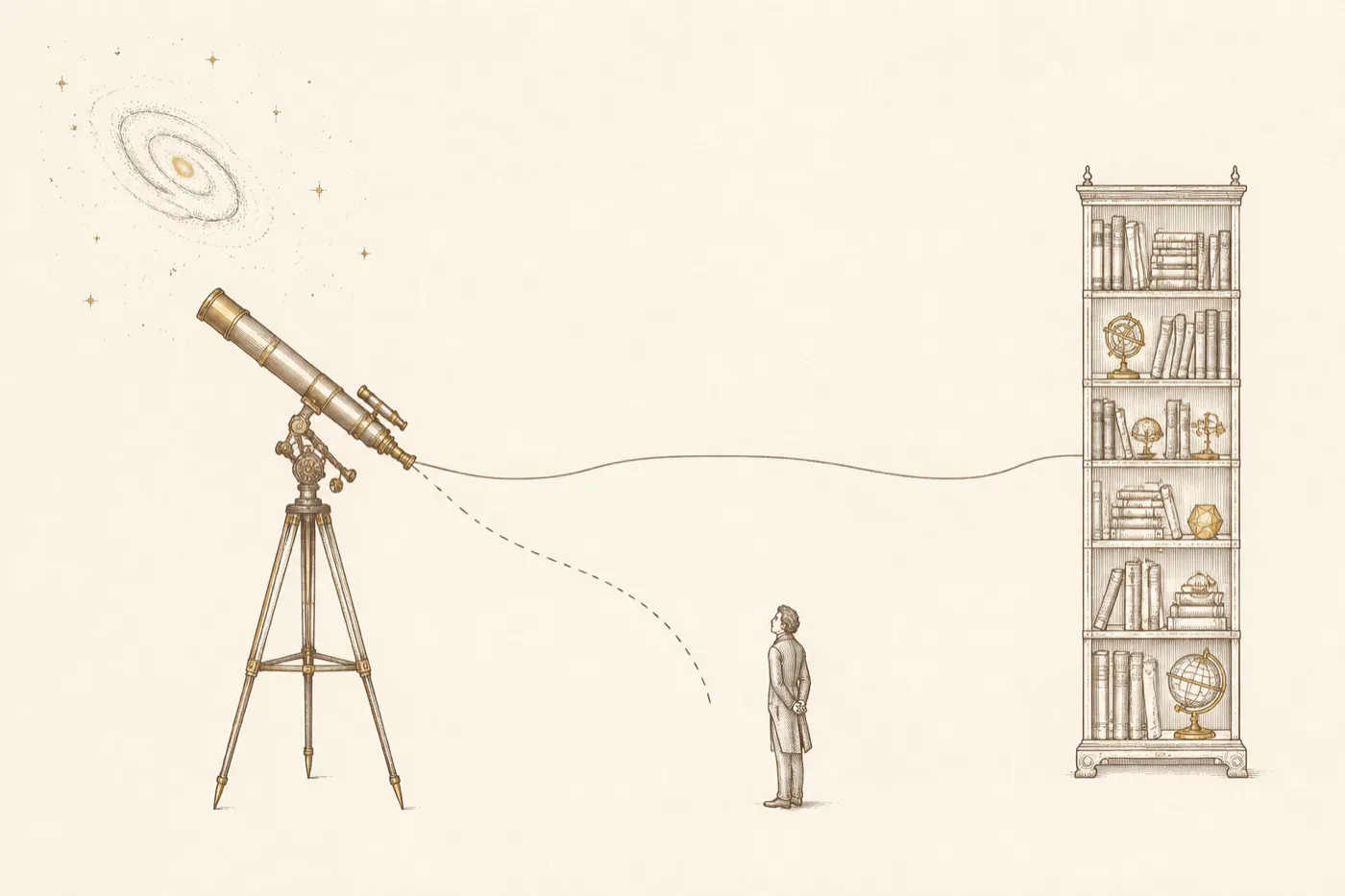
That is not an insult to the species. It is the most consequential fact about it, and it is the reason a machine is a different case rather than a faster version of the same case.
The rate, honestly stated
It is fashionable to say that biological evolution is slow and machine iteration is fast, and the comparison is usually made in a way that flatters the speaker. So let us make it carefully, in both directions.
Pull the scale back and the human loop is not slow at all. It is the fastest thing this planet has produced. Single cells to a species that models its own origins is an astonishing rate of change; it only looks glacial because we are inside one frame of it. And the loop is genuinely closed at every point along the way. Skin pigmentation across latitudes is the environment’s answer, applied. Brain volume is the environment’s answer, applied. Nothing was taught and nothing was designed. Variants were proposed at random, the world rejected most of them in the only way it knows how, and what remained was, in the strict sense, learned.
But the clock of that loop is a generation, the write is involuntary, and the currency of rejection is a life. Those three properties are not incidental — together they are why the loop cannot be steered from inside. You do not get to decide what your descendants are born knowing. You do not get to run the experiment twice.
A system built out of computation has none of those three constraints, and the third one matters more than the first. When rejection stops costing a life and starts costing a few minutes of compute, deliberate selection becomes possible for the first time. Blind selection is what you do when discarding is expensive; you propose at random and let the world do the arithmetic. Cheap discarding is what makes it affordable to propose on purpose, look at what came back, and try the next thing before lunch. Speed is the least interesting part of the difference. Reversibility is the whole of it.
What actually transfers
We are not claiming that a model is an organism, and we are wary of the argument by analogy that usually follows a paragraph like the last one. The forms differ, and they differ concretely. A model has no scarcity of copies. Its inheritance can be edited directly. Its failures are recoverable, which is exactly why they can be studied rather than merely survived. And the loop can be run without anyone dying, which is such a large change in the moral situation that treating it as a mere efficiency gain seems to us a category error.
What transfers is not the biology. It is the shape.
Three surfaces on which an improvement can be stored, with different costs and different lifetimes. A signal that only ever arrives after the attempt. A rule about what gets kept, standing above the whole arrangement and answerable to something the process cannot edit. That is the architecture of every improving system we know of, from a bacterium to a civilisation, and it is the architecture we think a self-improving machine has to be built out of — not because nature is a good designer, but because nature has run the only long experiment on the subject and left the results lying around.
The rest of this series takes the three surfaces one at a time and then returns to the thing above them. The next essay is about the hardest of the three, which is not the weights and not the tools. It is the question of how a system finds out what it does not know.