
A student gets a problem wrong. What have you learned?
Almost nothing, and the trap is that it feels like a great deal. The obvious reading — they do not know this, so teach it to them — is the reading that ruins curricula, and it has ruined a fair number of machine-learning pipelines too. A wrong answer is not evidence of missing knowledge. It is evidence of a missing outcome, which is a much weaker thing to have observed.
Between those two lies the whole subject of this essay.
Three regions, not two
Watch the same student long enough and the failures separate into kinds. Sometimes every fact needed for the answer appears in their own working, arranged badly, and the conclusion arrives anyway from the wrong direction: they had it, and did not deploy it. Sometimes they know the thing under a different name and never noticed it was the same thing. And sometimes the knowledge is simply not there, in any form, under any name.
Three regions: what is held, what is held and misapplied, and what is absent. The intervention that fixes each is different from the intervention that fixes the other two, and conflating them is expensive in a specific and boring way — you spend your entire budget re-teaching material the student already commands, while the actual gap goes untouched because nothing in the process was ever able to see it.

So the first job of a data loop is not to generate anything. It is to draw that line. Run the system many times on the same competence and record two different things: how often it succeeds, and how often the material required for success shows up in its own trace regardless of whether the answer came out right. The two numbers together say which region you are in. The first alone never will, and a loop steered by the first alone is guessing.
The easy half
Once the line is drawn, the region on the near side of it is straightforward, and it is what most data-centric work already does well. The system demonstrably has these capabilities; it just does not deploy them reliably. So take what it did when it happened to get things right, verify it, and press it into a form that can be practised. Amplify the signal that is already present.
We call this positive amplification, and the honest description of it is that nothing new enters the system. It is a teacher who watched a student stumble into a correct method by accident and now makes them do it again on purpose, ten times, until the accident becomes a habit. Valuable — most of what separates competence from mastery is exactly this — and cheap, because the material is generated out of the system’s own behaviour rather than acquired from anywhere.
It is also strictly bounded. You cannot press out what was never there. Any loop built only on this half will improve until it reaches the edge of what the system already contains, and then it will keep running, keep spending, and stop improving, and from the inside those two states look the same.
The half that decides everything
Which leaves the far region, and the temptation there is symmetry: if we synthesised lessons for the capabilities the system has, let us synthesise lessons for the ones it lacks.
This is the operation that does not work, and it is worth being exact about why. A lesson about something a system does not know must be written by that same system, which by construction does not know it. What comes out is not knowledge. It is a fluent impersonation of knowledge — correctly formatted, plausibly worded, indistinguishable at the surface from a real lesson, and wrong. Train on it and you have not left the capability untouched; you have taught a falsehood with the full weight of instruction behind it. Confident error is worse than an acknowledged gap, because a gap can be filled and a confident error has to be found first.
The move that makes the far region useful is to stop treating it as a place to generate lessons at all.
Negative knowledge is a specification, not a sample. What the boundary produces is a question. The failures that led there, the difficulty at which competence collapsed, and a statement of what would settle the matter. That is not teaching material. It is a well-posed request, and the only correct response to a question a system cannot answer is to go and find out.
Finding out means letting information in from outside — search and literature for what exists publicly and was simply never acquired; a curated corpus where provenance matters; an expert asked a narrow question; and, when the answer is not written down anywhere, a measurement. The rungs are in ascending order of cost, and the ordering is the point. Each one is a channel through which entropy the system did not already contain enters it, and each one is expensive enough that you want to be certain the gap is real before you pay.
Sharpening the edge on purpose
Which means the boundary itself has to be measured rather than assumed, and this is the part that reads as strange the first time. Alongside the probing that tries to succeed, the loop runs probing that is designed to fail: pushing at increasing difficulty until the competence gives out, deliberately, to find out exactly where it gives out.
The objective is inverted. You are not trying to get the answer right; you are trying to locate the last point at which the system could. An examination has the same double character — an exam that everyone passes has measured nothing, and the items that discriminate are the ones near the edge. But the framing is usually apologetic, as though difficulty were a regrettable necessity. Here it is the product. The boundary, accurately drawn, is the most valuable object the loop produces, and it is worth spending real budget to draw it sharply.
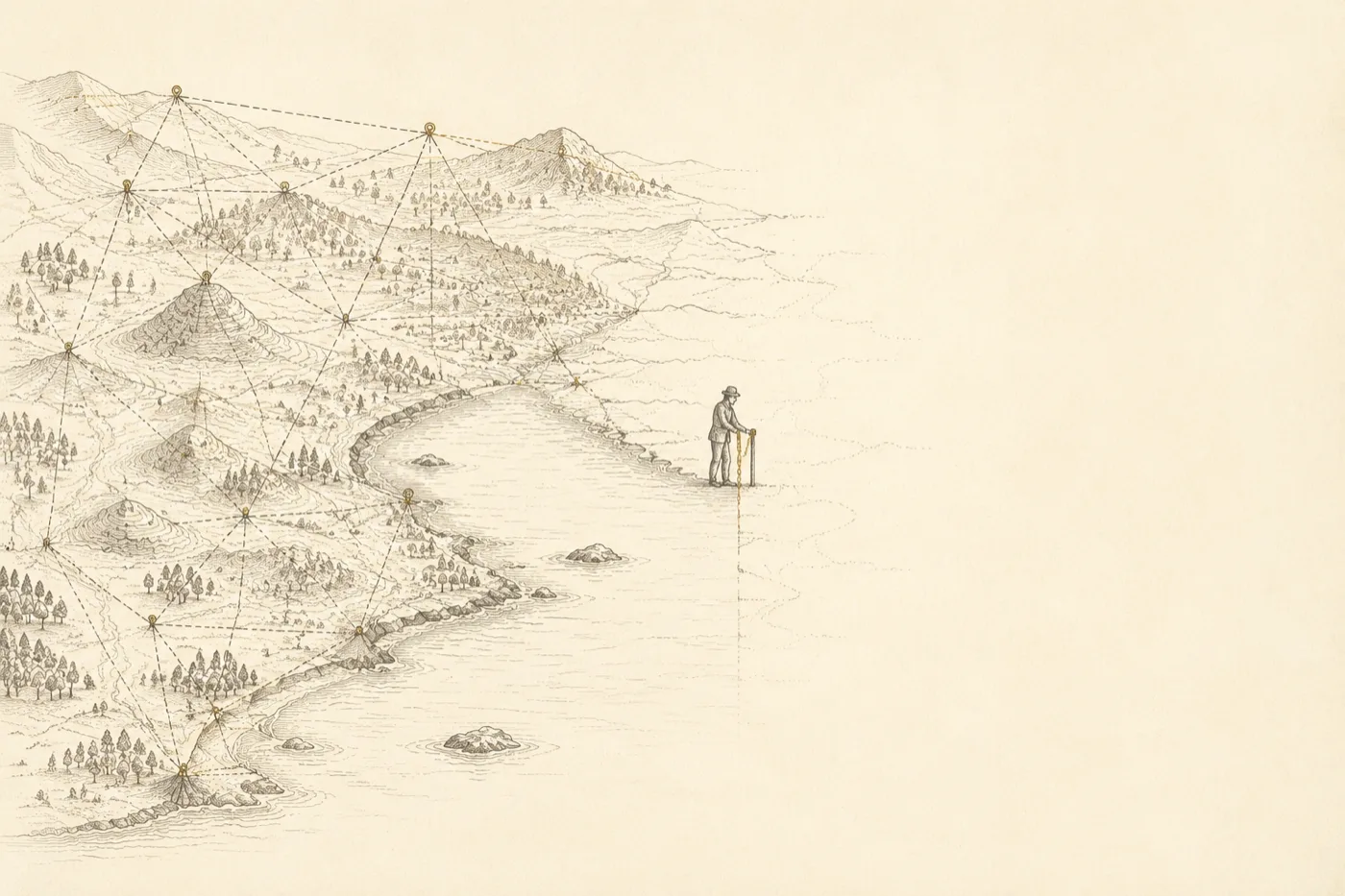
Selection, we would point out, has never done anything else. The environment does not teach. It has no content to transmit. Its entire contribution is to say no, precisely, at a particular boundary — and the new information that eventually crossed that boundary always came from somewhere else: a mutation, a migration, a continent nobody had stood on. Negative signal locates the gap. It never fills it. Every improving system in history has needed a second channel for that, and the ones that pretended otherwise went in circles.
Grounding, not laundering
There is a failure mode on this path that deserves naming, because it is so easy and so quiet. Material comes in from outside; it gets reworded; it goes into the training set with a citation attached and the citation is doing no work. Synthesis-for-the-absent-region has re-entered through the back door wearing a source’s coat.
Three disciplines keep the distinction real, and none of them is sophisticated. Retrieved material is a source against which a lesson is written and checked, never an answer transplanted whole. Every record keeps a reference to the document that licensed its claims, so a statement can be traced to what justified it rather than to the model that phrased it. And — this is the one that is skipped most often — the gap is not marked closed by the act of acquiring the material. It is re-probed. It leaves the absent region when the measurement says it has, not when the paperwork says it has.

That third discipline is the difference between a system that knows more and a system with a tidier ledger.
An ignorance you can point at
The practical value of all this is not that it produces better data, though it does. It is that it makes external supervision scarce and aimed.
Without the partition, a loop has two ways to fail and no way to tell which it is doing. It can generate indiscriminately — spending its budget re-teaching what is mastered and hallucinating over what is not. Or it can acquire indiscriminately — buying corpora and expert hours against gaps it cannot demonstrate are real. With the partition, the division of labour is clean: everything up to the boundary is addressable from the system’s own output, and every unit of external cost is spent past it.
In the domains that matter most, that division is the whole product. A laboratory that can afford fifty experiments a month does not need a system that proposes five thousand. It needs to know which fifty. An expert who would refuse to write a curriculum will answer a precise question in a paragraph. The scarce resource in all of these cases is not generation, which is now nearly free, and not effort. It is a defensible reason to prefer one thing to work on over another.
That is what a measured boundary is. Not a list of everything unknown — the universe supplies that for free — but a small, dated, checkable statement of where this system’s competence ends, produced by observation rather than by opinion. An ignorance you can point at stops being ignorance in the ordinary sense. It becomes a plan.